
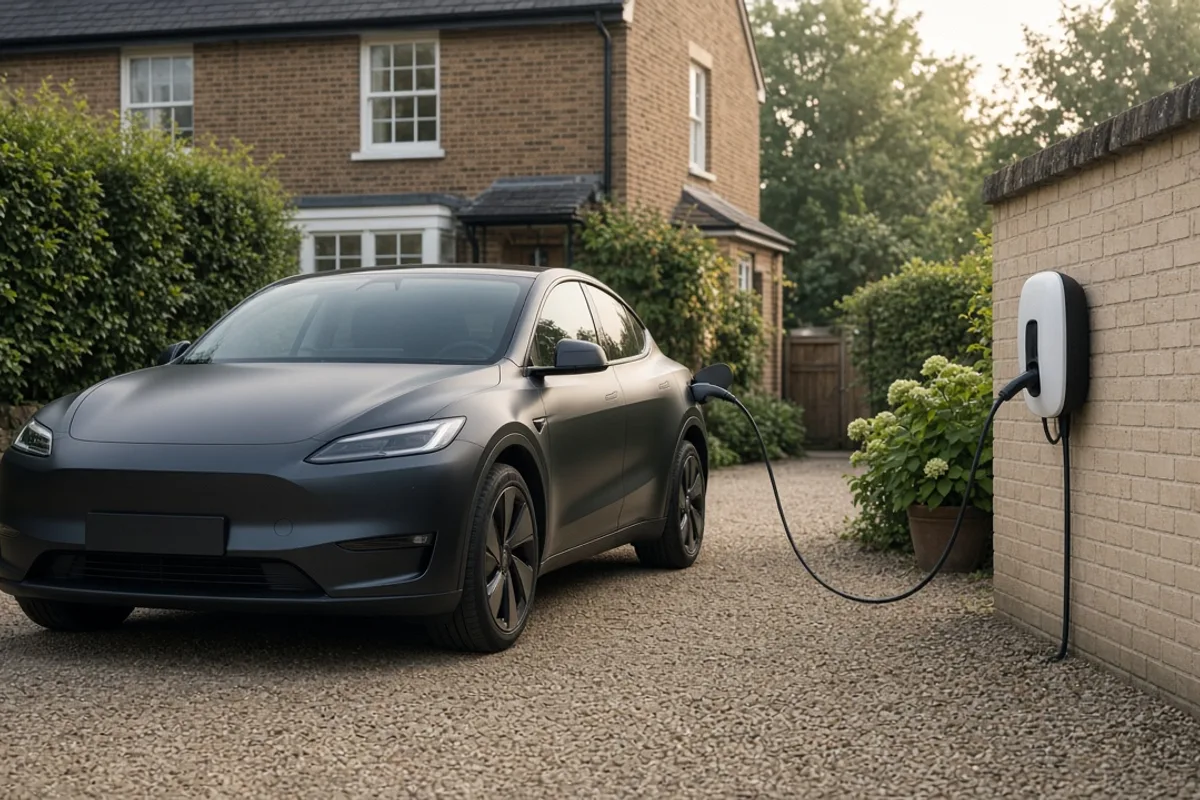
Most electric cars refill overnight on a 7kW home charger. The number that matters for home charging is the car's maximum AC rate, not its rapid-charging speed: a car that takes 11kW or 22kW still charges at about 7.4kW on the single-phase supply almost every UK home has.
How the times are worked out
Each time is the usable battery divided by the charging rate, with about 10% added for charging losses. A 3-pin plug is taken as 2.3kW, a home wallbox as 7.4kW or the car's own limit if lower, and three-phase as 11kW or 22kW where the car can accept it. Real sessions vary with temperature, battery condition and the charge limit you set, and most of the time you will be topping up rather than charging from empty.
What the columns mean
- Home AC is the most the car takes on a normal single-phase home supply, capped at 7.4kW.
- Three-phase is what it can take on a three-phase supply. Few homes have one, so this mainly matters for workplaces and some new builds.
- Charge port shows where the socket is, which decides where the wallbox should go and how long the cable needs to be. Left means the nearside on UK roads.
- Plug-in hybrids often charge at only 3.3kW to 3.7kW, so a faster wallbox will not fill them any quicker.
Using this before you buy a charger
If your car charges at 7kW or more, a standard 7kW smart charger is the right match. If it is limited to around 3.6kW, any good wallbox will do and you do not need to pay for extra power. Before you get quotes, note the port position and where you park, then read the best home chargers compared and what installation costs.
Frequently asked questions
How long does an electric car take to charge at home?
On a standard 7kW home charger most electric cars charge from empty to full in roughly 6 to 15 hours, depending on battery size. Most nights you only top up, which takes a few hours. On a 3-pin plug the same charge takes two to three times longer.
Why does my car only charge at 7kW at home?
Almost all UK homes have a single-phase supply, which limits a home charger to about 7.4kW. A car that can accept 11kW or 22kW only charges faster on a three-phase supply, which few homes have.
Is a 22kW home charger worth it?
Only if your home already has a three-phase supply and your car can accept 22kW on AC. Few can as standard: the Renault Zoe, most smart #1, #3 and #5 versions, Lotus, the Rolls-Royce Spectre, Maserati Folgore models, the Volvo EX60 and the Range Rover Electric. Several others offer 22kW as an option. For most homes a 7kW charger is the right choice.
How long does a plug-in hybrid take to charge at home?
Most plug-in hybrids have batteries of about 12 to 25 kWh and charge at 3.3kW to 7.4kW, so a full charge takes roughly two to six hours. A wallbox is still worth having for safety and to use cheap overnight rates.
Where is my car's charge port?
It varies by model. Teslas, Volvos and Polestars charge from the rear left, most Volkswagen, Skoda, Cupra, BMW and Mercedes electric cars from the rear right, newer small Kias and Hyundais from the front right, and cars such as the older Nissan Leaf and Kia Niro EV from the front centre. Knowing the port position helps decide where the wallbox goes and how long the cable needs to be.
Why does my plug-in hybrid charge slowly on a 7kW charger?
Many plug-in hybrids take only 3.3kW to 3.7kW on a single-phase home supply. Some newer ones, including the 2024-on Volkswagen Golf, Tiguan and Passat eHybrid, accept 11kW but only on a three-phase supply, so at home they still charge at about 3.7kW. The table shows the single-phase figure that applies to most homes.