
Home EV running costs in 2026 are driven mainly by how many kWh you draw and the unit rate that applies when you charge, not by the wallbox itself. A simple planning method is miles driven times kWh per mile times your applicable pence per kWh. Standing charges are billed for having a supply and should not be treated as part of the per-mile EV figure unless you are comparing whole household bills. Public rapid charging usually costs more per kWh than controlled overnight home charging. All unit rates quoted in guides are illustrative. Your tariff schedule and vehicle efficiency set the real number.
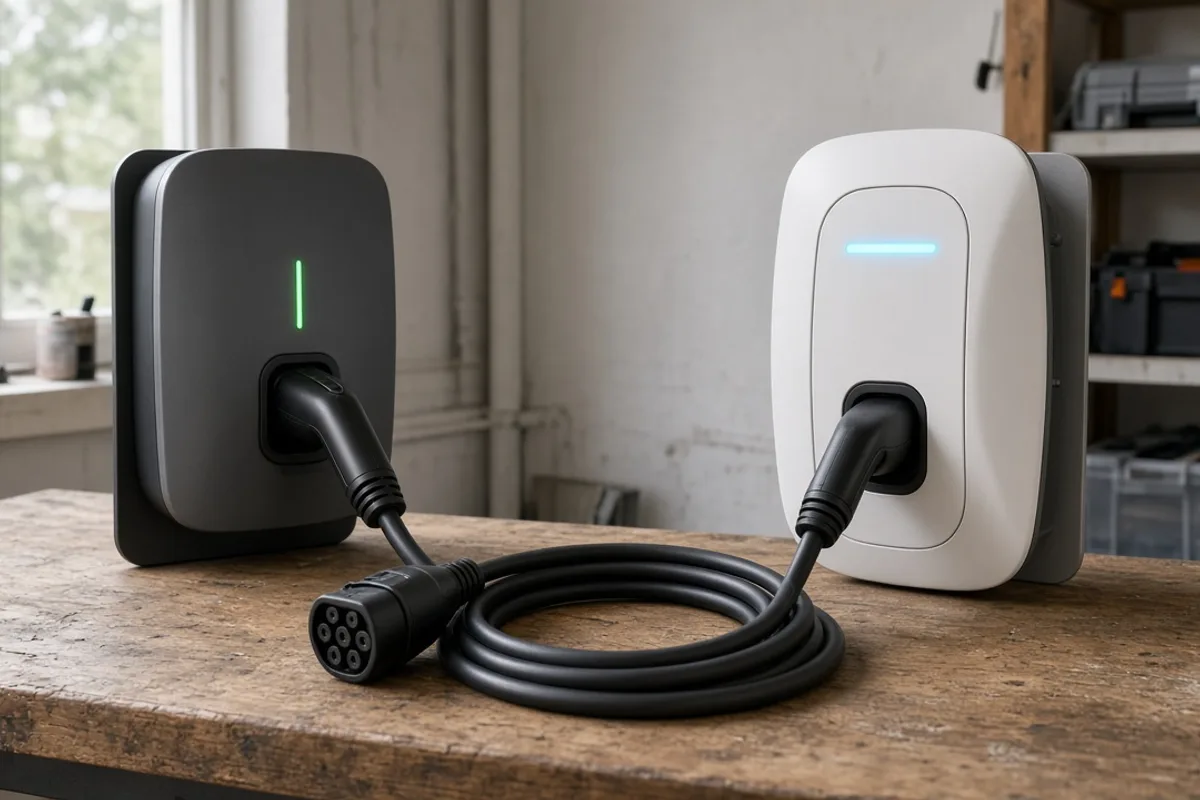
The basic home charging formula
Start with monthly miles, convert using a realistic kWh per mile for your vehicle and season, then multiply by the unit rate that applies in the hours you actually charge. Cold weather, motorway speeds and cabin heating raise consumption above brochure figures.
If you charge 250 miles worth of energy in a month at 0.3 kWh per mile, that is about 75 kWh. At an illustrative 15p per kWh off-peak rate, energy cost is around £11.25 for that block. At an illustrative 28p per kWh flat rate, the same energy is about £21. These figures are worked examples, not forecasts of your bill.
- Use your car's reported efficiency after a few weeks, not only WLTP marketing.
- Separate energy cost from parking fees and public charging idle fees.
- Keep the wallbox standby draw in perspective. It is usually tiny next to propulsion energy.
Unit rates versus standing charges
Unit rates pay for each kWh. Standing charges pay for the connection and are largely independent of whether you charge an EV. Adding an EV does not create a second standing charge on the same meter.
When people say home charging is expensive, they sometimes fold the whole electricity bill into the car. A fair EV comparison uses the incremental kWh and the rate band those kWh used.
Time-of-use nuance
Overnight EV tariffs can cut the effective rate sharply if most charging lands inside the cheap window. Miss the window and you may pay a higher day rate than a simple single-rate deal.
Smart scheduling, vehicle timers and charger apps should agree on the same clock and tariff calendar, including weekends and clock changes.
Home versus public charging mix
Many drivers still use public networks for journeys and rely on home charging for routine miles. Blend the costs honestly: a monthly rapid top-up can dominate the spreadsheet even when most miles are home charged.
Zapmap and network apps help you compare public prices, but home estimates still need your tariff files from the supplier, not a national average alone.
What does not belong in the running-cost figure
Installation capital cost, grant paperwork and driveway works belong in ownership cost, not pence-per-mile energy cost. Maintenance of the charger is usually low if the install was sound.
Use budgeting bands for install decisions and metered kWh for running-cost decisions. Mixing the two creates false precision.
Frequently asked questions
Does a bigger charger cost more to run?
Not for the same kWh. Seven kW delivers energy faster than 3 kW, but a kWh is a kWh at a given unit rate. Faster charging mainly changes whether you finish inside a cheap window.
Should I include the standing charge in EV cost per mile?
Usually no for incremental EV comparisons on an existing household supply. Include it when you compare whole-bill outcomes or a second dedicated supply.
Why is my real cost higher than online calculators?
Calculators often assume ideal efficiency, perfect off-peak discipline and a national illustrative rate. Your driving style, weather and tariff may differ.
Do I pay standing charge twice if I own an EV?
Not on a single domestic meter. You still pay one standing charge for the supply, plus unit charges for all household and EV electricity.
Core buying guides
Start with these high-intent guides, then dig into the rest of the library.
Related guides
Sources and further reading
How this guide was prepared
This guide was written by the Local EV Installers Editorial Team. We compare official guidance, legislation and established consumer information, separate general information from project-specific advice, and show publication dates and sources. We do not accept installer accreditation claims at face value.