
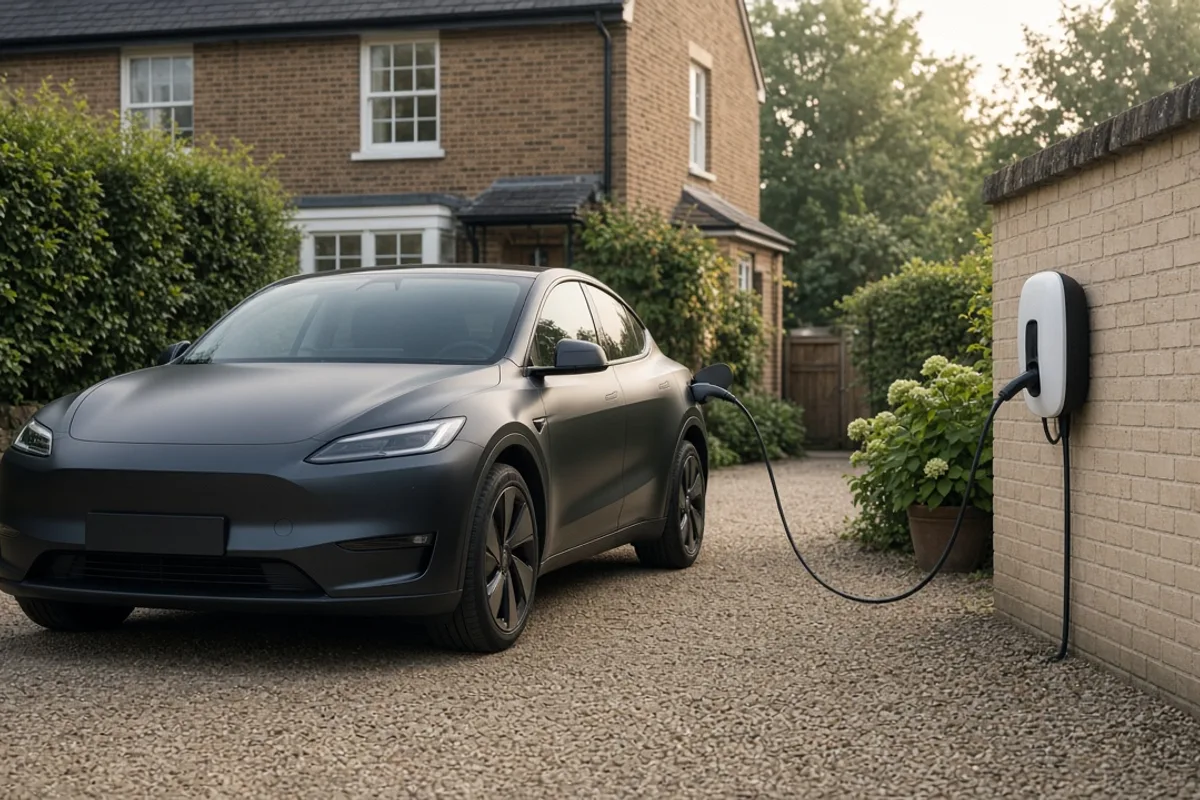
Every current Tesla accepts up to 11kW on AC, so a standard 7kW single-phase wallbox charges any of them overnight. You do not need a Tesla Wall Connector: any Type 2 charger works. The two things to settle are open-PEN protection, which the Wall Connector does not include, and whether you want the car or the charger to manage smart-tariff scheduling.
Tesla home charging times by model
Of the Tesla models below, the Model 3 Rear-Wheel Drive refills fastest at home, about 8.5 hours from empty, while the Model S and Model X needs about 14.5 hours. Daily top-ups take far less.
| Model | Type | Battery | Max AC charging | 0 to 100% on 7kW |
|---|---|---|---|---|
| Model 3 Rear-Wheel Drive | Electric | about 57.5 kWh | 11kW | about 8.5 hours |
| Model 3 Long Range | Electric | about 75 kWh | 11kW | about 11.5 hours |
| Model Y Rear-Wheel Drive | Electric | about 60 kWh | 11kW | about 9 hours |
| Model Y Long Range | Electric | about 75 kWh | 11kW | about 11.5 hours |
| Model S and Model X | Electric | about 95 to 100 kWh | 11kW | about 14.5 hours |
Wall Connector or a third-party charger?
Tesla's Wall Connector is a tidy, tethered unit with a long cable and it works with any Type 2 car, but in the UK it does not have built-in protection against an open-PEN fault. On the usual PME supply your installer has to add that, either with a separate PEN-fault device or an earth rod, which adds cost and a second box on the wall.
Chargers such as the Ohme Home Pro, Hypervolt Home 3, myenergi zappi and Pod Point Solo 3S include open-PEN protection, so the fitted price is often similar or lower. Teslas also schedule charging well from the car's own app, so you lose little by choosing a non-Tesla charger.
- Ask every installer how they will provide open-PEN protection and price it in
- Choose a cable long enough to reach the charge port, which is on the rear left corner (the kerb side when you park nose-in on a UK drive)
- Confirm whether the quote includes Wi-Fi setup for smart charging
Smart tariffs and scheduling
Teslas can join some smart tariffs through the car itself, which means the energy supplier schedules charging via the Tesla app rather than the wallbox. That lets you use a simpler charger, but check the supplier's current list of supported cars before you commit.
If you prefer the charger to do the scheduling, pick one that your intended tariff supports directly. Either way, set the car's own charge limit to around 80 to 90% for daily use unless your Tesla has an LFP battery, where Tesla recommends charging to 100% at least once a week.
When three-phase makes sense
Teslas can take 11kW, but almost all UK homes have a single-phase supply that tops out at 7.4kW. Upgrading to three-phase only for a faster home charge rarely pays back. An 80 kWh Tesla still refills overnight on 7kW.
Frequently asked questions
Do I need a Tesla Wall Connector to charge a Tesla at home?
No. Any Type 2 home charger will charge a Tesla. The Wall Connector needs extra open-PEN protection in most UK homes, so a charger with that built in can work out cheaper to fit.
How long does a Tesla take to charge at home?
On a 7kW wallbox an empty Model 3 or Model Y takes roughly 9 to 12 hours depending on battery size. A typical overnight top-up of 50 to 80 miles takes two to four hours.
Can I charge a Tesla from a three-pin plug?
Yes, using Tesla's mobile connector or a portable charger, but at about 2.3kW it adds only around 7 to 8 miles of range an hour. It is fine occasionally but a wallbox is far better for daily use.
Core buying guides
Start with these high-intent guides, then dig into the rest of the library.
Related guides
Sources and further reading
How this guide was prepared
This guide was written by the Local EV Installers Editorial Team. We compare official guidance, legislation and established consumer information, separate general information from project-specific advice, and show publication dates and sources. We do not accept installer accreditation claims at face value.