
The four routes, and who decides each
About 8 million households in England have no off-street parking, according to the English Housing Survey figures the government quotes, and almost 4 million of them have adequate on-street parking. Those homes can now charge from their own electricity supply in more ways than a year ago.
| Route | Who must agree | Planning in England | Grant |
|---|---|---|---|
| Pavement channel and a home charger | The highway authority | Permitted development since 21 October 2026, outside conservation areas and listed buildings | 75% up to £500 |
| Dropped kerb and a driveway | The highway authority | Permission needed on a classified road, and for flats | None for a house you own |
| Your own space at a flat or rented home | Landlord or freeholder | Permitted development within size limits | 75% up to £500 |
| Public and workplace charging | Council or employer | Not yours to obtain | Up to £500 per socket, paid to the employer |
Pavement channels: what the rules now say
A pavement channel, also called a cable gully, is a narrow covered slot set flush into the footway. You press the charging cable into it while the car charges and lift it out afterwards. The government's guidance for councils, updated on 4 November 2026, says the decision to allow one rests with the local authority and sets out what it should weigh: whether you can park by your home, the width and construction of the pavement, yellow lines and junctions, and utility covers and tree roots on the route.
- Consent comes first. The highway authority must agree, and the channel is installed by it or by a contractor it approves. You must not install anything in the public pavement yourself.
- Planning is now simpler in England. A channel installed with the highway authority's authorisation is permitted development, and so is one charger within your boundary, up to 1.6 metres high. Conservation areas and listed buildings are excluded and need an application.
- The cable must use the channel. A charger fitted under the new right carries a condition that, where a footway lies between it and the car, the cable crosses only through an authorised channel.
- It does not reserve the space. The guidance says a channel gives no ownership of or priority to the parking space, and suggests it works best where you can park by your home at least once a week.
- Expect an agreement. Councils use a licence or user agreement covering fees, maintenance, insurance and what happens when you move. Milton Keynes, Oxfordshire and Nottinghamshire are the worked examples in the guidance.
The £500 grant, and the order that matters
The chargepoint grant for households with on-street parking pays 75% of the cost of buying and installing one socket, up to £500, until 31 March 2027. It cannot be backdated, so the order matters: permission from any landlord or freeholder, then the highway authority's consent, then the grant application, and only then installation by an OZEV-approved installer. Cable covers and mats laid over a cable do not count as a cross-pavement solution.
Renters and flat owners with their own off-street space use a separate grant at the same rate. There is no grant for a house you own that already has off-street parking.
What is in the pack
The route check above is free. The pack is the paperwork for your route, for £19, written from your answers.
| Document | What it does |
|---|---|
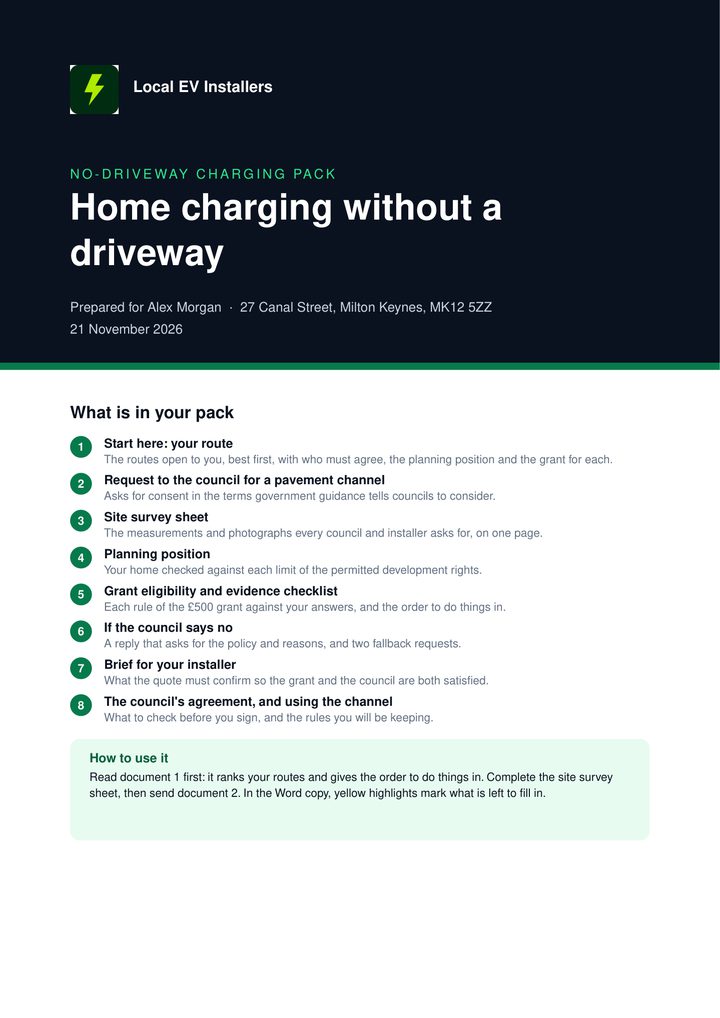
| 1. Start here: your route | The routes open to you, best first, with who must agree, the planning position and the grant for each. |
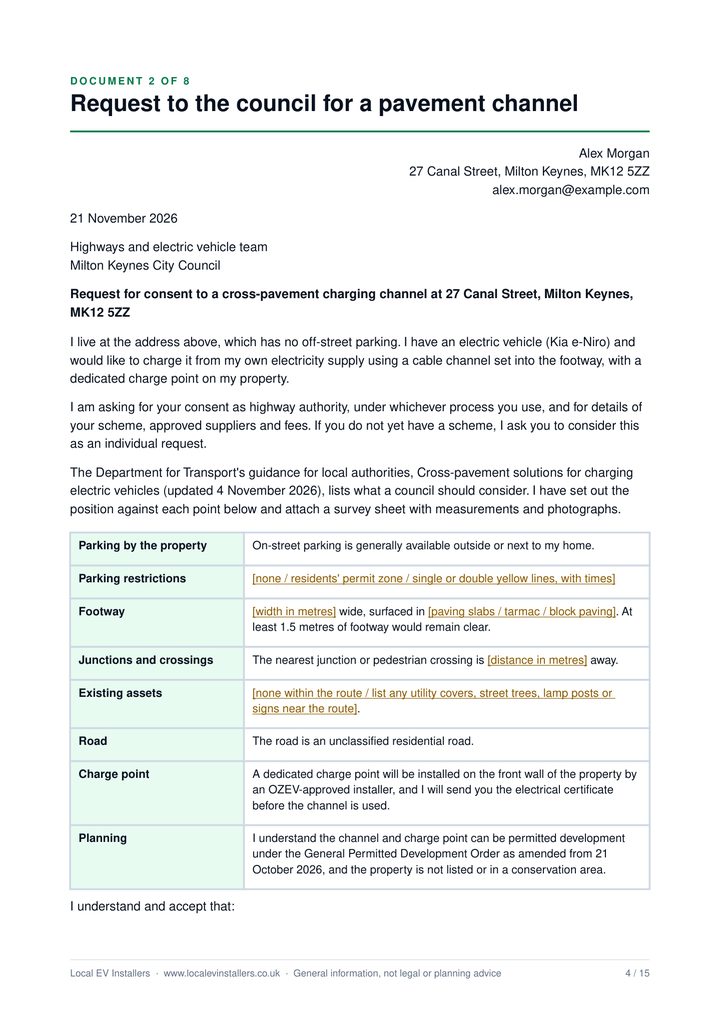
| 2. Request to the council for a pavement channel | Asks for consent in the terms government guidance tells councils to consider. |
| 3. Site survey sheet | The measurements and photographs every council and installer asks for, on one page. |
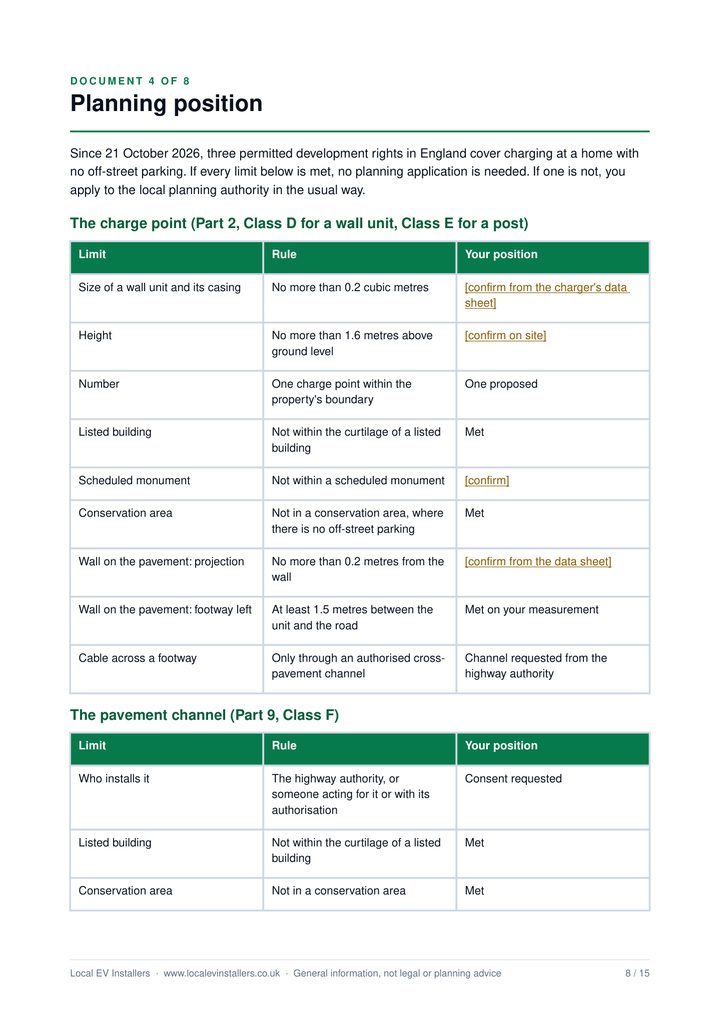
| 4. Planning position | Your home checked against each limit of the permitted development rights. |
| 5. Grant eligibility and evidence checklist | Each rule of the £500 grant against your answers, and the order to do things in. |
| 6. If the council says no | A reply that asks for the policy and reasons, and two fallback requests. |
| 7. Brief for your installer | What the quote must confirm so the grant and the council are both satisfied. |
| 8. The council's agreement, and using the channel | What to check before you sign, and the rules you will be keeping. |
The documents change with your answers. A renter or flat owner gets letters to the landlord or freeholder. A home with a front garden gets a dropped kerb section. A flat with its own space gets the flats and renters grant route and no pavement paperwork. Download the full sample.
Who it is for
- Terraced and town-centre homes with on-street parking.
- Renters and flat owners who need permission before they can apply for a grant.
- Anyone weighing a dropped kerb against a pavement channel.
It is not for a house you own that already has a driveway or garage: a standard installation applies, so get quotes instead. For more background, read the cross-pavement charging guide and dropped kerbs before an EV charger.
Frequently asked questions
How do I ask my council for a pavement charging channel?
Contact your highway authority, which is usually the county, unitary or metropolitan council's highways team, and ask whether it allows cross-pavement channels and how to apply. The government's guidance for councils, updated on 4 November 2026, says the decision rests with the local authority and lists what it weighs: whether you can park by your home, the width and construction of the pavement, yellow lines and junctions, and utility covers and tree roots on the route. Put those points in your request, and expect a licence or user agreement if the council says yes. The paperwork pack writes this request for you from your answers.
Can I have a home EV charger without a driveway?
Often, yes. Where your council allows it, a slim channel is set into the pavement so the charging cable can cross safely from a charger on your property to your car on the street. Since 21 October 2026 the channel and the charger can both be permitted development in England, and a government grant pays 75% of the charger's cost up to £500.
Do I need planning permission for a charger if I have no off-street parking?
Not in England if the limits are met. From 21 October 2026 a wall charger or post within the boundary of a house or block of flats is permitted development even with no off-street parking, provided it is no higher than 1.6 metres, not at a listed building and not in a conservation area, and the cable crosses the footway only through a channel authorised by the highway authority. A charger on a wall that adjoins the pavement must leave at least 1.5 metres of footway.
Is the pavement channel itself permitted development?
Yes, in England, when it is installed by the highway authority, for it, or with its authorisation, and it is not in a conservation area or the curtilage of a listed building. You still need the highway authority's consent, and you must not install anything in the pavement yourself.
How much is the grant for homes with on-street parking?
75% of the cost of buying and installing one charge point socket, up to £500. The maximum rose from £350 on 1 April 2026 and funding is confirmed until 31 March 2027. You need the highway authority's consent for a permanent cross-pavement solution before you apply, and the charger must not be installed until the grant is confirmed.
Can I just run a cable across the pavement with a cable cover?
Not without your council's agreement. The Highways Act 1980 requires the highway authority's consent to place a cable across a highway, and makes it an offence to place a wire across one in a way likely to cause danger. Cable covers and mats are treated as temporary solutions and do not qualify for the grant.
Does a pavement channel reserve the parking space outside my house?
No. Government guidance is explicit that a channel gives no ownership of, or priority over, the space outside your home, and councils forbid cones or signs. It works best where you can usually park by your home at least once a week.
What if my council does not allow pavement channels?
The decision rests with the council, and not all of them have a scheme yet. Ask for the policy and the reasons in writing, and ask whether it has funding from the government's EV Pavement Channels Grant. Your ward councillor is the next step. The fallback routes are a public charger on your street and charging at work.
Do I need planning permission for a dropped kerb?
It depends on the road. Forming an access on to a classified road, which means an A, B or C road, needs planning permission. On an unclassified road it can be permitted development for a house, and paving more than 5 square metres of front garden must be porous or drain to a permeable area. The highway authority's approval of the crossing is always needed as well.
Can renters and flat owners get a charger grant?
Yes. The grant for renters and flat owners pays 75% up to £500 if you have a private off-street parking space you are legally entitled to. Renters without one can use the on-street parking grant with a pavement channel. Either way you need your landlord's or freeholder's permission before applying.
Is there a grant if I own a house with a driveway?
No. The chargepoint grants are for people who own a flat, rent their home, or have only on-street parking and are installing a pavement channel.
Does this apply in Scotland, Wales and Northern Ireland?
The grants cover the whole UK. The planning rights described here are for England only, and roads are devolved, so in Scotland, Wales and Northern Ireland you ask your own roads authority and planning authority what they allow.
What if the pack is not what I expected?
Reply to the delivery email within 14 days and we will put it right or refund you.
Sources
- GOV.UK: cross-pavement solutions for charging electric vehicles (updated 4 November 2026)
- Find a grant: EV chargepoint grant for households with on-street parking
- Find a grant: EV chargepoint grant for renters and flat owners
- GOV.UK: changes to EV chargepoint grant schemes from 1 April 2026
- UK legislation: GPDO Part 2 Class D, electrical outlet for recharging vehicles
- UK legislation: S.I. 2026/1056, the amendment order of 21 October 2026
- UK legislation: Highways Act 1980, section 184, vehicle crossings
- GOV.UK: apply for a dropped kerb