
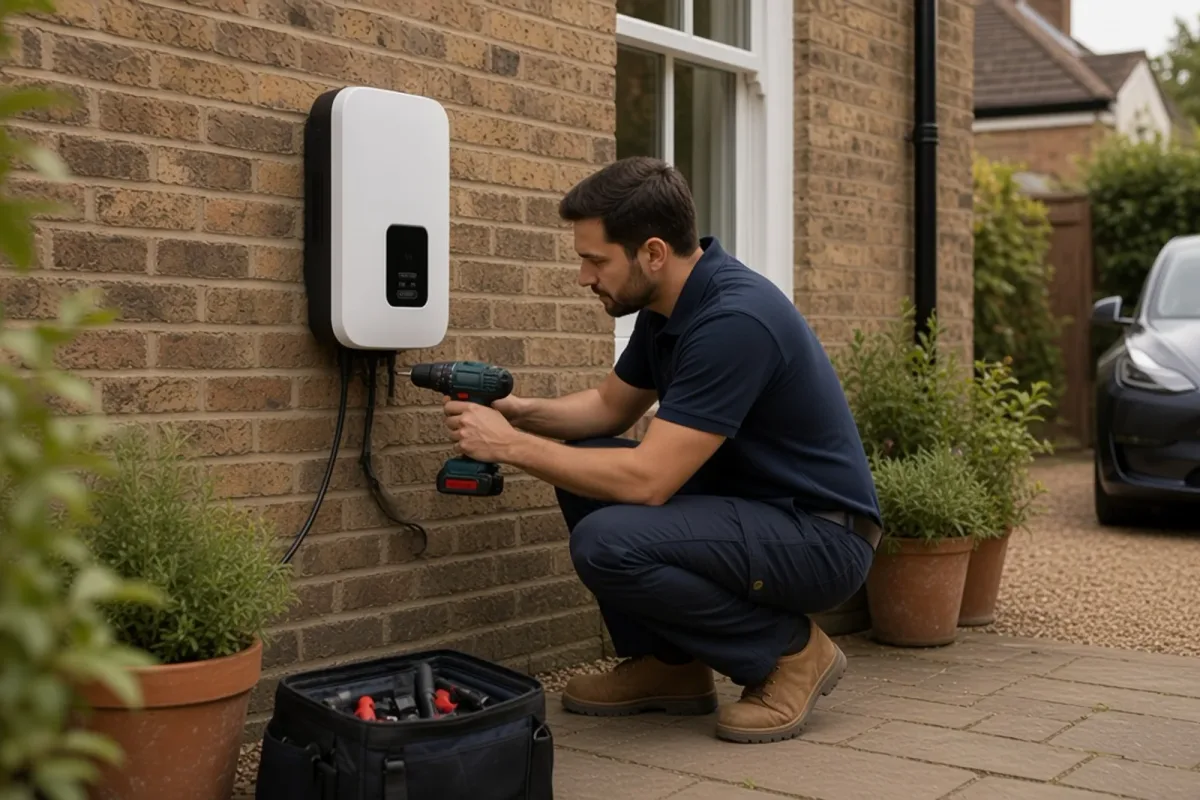
Many UK councils fit EV chargers into street lamp columns or install small kerbside posts, so drivers without a driveway can charge near home overnight. They usually charge at around 3 kW to 7 kW on AC, enough to add a good number of miles overnight. You pay through an app or card at the operator's rate, which is usually higher than a home EV tariff. Residents can often request one through their council.
How lamp column charging works
The charger is built into or attached to the lamp column at the kerb, using the street lighting supply. You plug your own Type 2 cable into the socket, start the session in the operator's app and leave the car overnight.
Kerbside posts work the same way but stand on their own. Both are AC chargers, so they fill a car slowly, which suits overnight parking.
Speed and cost
Lamp column chargers typically supply around 3 kW to 7 kW. At 5 kW, ten hours adds roughly 50 kWh, which is more than most drivers use in a day.
The price is set by the operator. It is usually above home smart EV tariffs, which run at a fraction of the standard price cap rate, but below rapid charging. Check whether there are parking charges or time limits on the street.
| Option | Typical speed | Typical cost per kWh |
|---|---|---|
| Home charger on a smart EV tariff | 7 kW | Lowest |
| Lamp column or kerbside charger | 3 kW to 7 kW | Middle |
| Public rapid charger | 50 kW and above | Highest |
Getting one on your street
Councils plan on-street charging with funding schemes and operators. Many have a request form on their website where residents can ask for a charger near home. Requests from several neighbours on the same street carry more weight.
Check your council's public charging page and the public charger league table on this site to see how many chargers your council already has.
Alternatives for drivers without a drive
Some councils allow cross-pavement solutions, where a cable channel lets you charge from your own home supply across the pavement. That gives you home tariff prices but needs council permission. See our guides to cross-pavement charging and to EV charging for terraced houses with street parking.
Workplace charging and supermarket chargers fill the gap for many drivers who cannot charge at home.
Frequently asked questions
How fast do lamppost EV chargers charge?
Typically around 3 kW to 7 kW, enough for a large overnight top-up.
Do I need my own cable for lamppost chargers?
Usually yes, a Type 2 cable.
How do I get a lamppost charger on my street?
Many councils have a request form on their website. Several requests from one street help.
Is lamppost charging cheaper than home charging?
Usually not. It costs more than a home smart EV tariff but less than rapid charging.
Core buying guides
Start with these high-intent guides, then dig into the rest of the library.
Related guides
Sources and further reading
How this guide was prepared
This guide was written by the Local EV Installers Editorial Team. We compare official guidance, legislation and established consumer information, separate general information from project-specific advice, and show publication dates and sources. We do not accept installer accreditation claims at face value.