
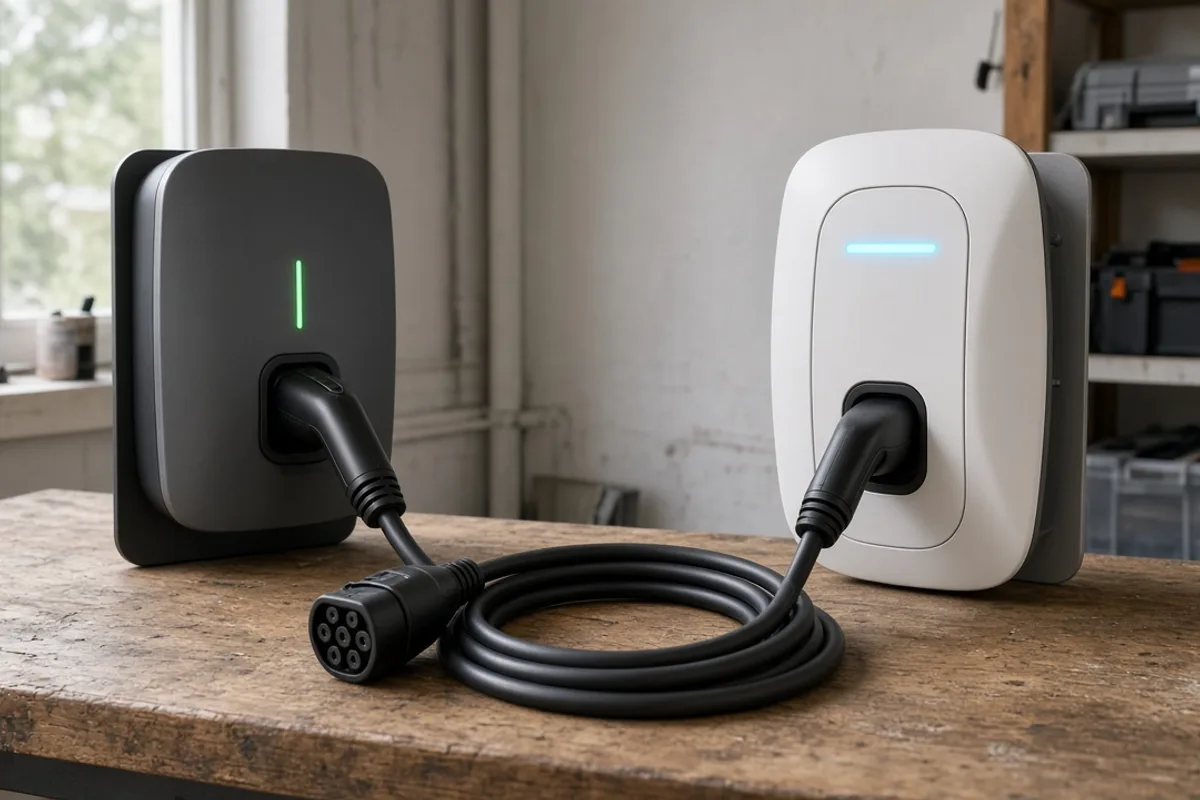
Two EVs can share one home charger if both cars do modest mileage, swapping plugs each night or alternating. If both need charging most nights, fit two chargers, or a twin-socket unit, with load management so the pair never overload the main fuse. On a typical single-phase supply, two cars charging at once share the available power, so each charges more slowly but both are usually full by morning.
Three ways to charge two cars
The right set-up depends on how far each car drives, how long they are parked at home and how much capacity your supply has.
| Option | Best for | Trade-offs |
|---|---|---|
| One charger, swap or alternate | Low daily mileage for both cars | Someone has to move the plug or the cars |
| Two chargers with load sharing | Both cars charge most nights | Two installations, but each car has its own plug |
| Twin-socket charger | Cars parked side by side | One unit; output shared between sockets |
| One charger with a long tethered lead | Two cars on one drive | Lead length and trip hazard |
Load management and the main fuse
Most UK homes have a 60, 80 or 100 amp main fuse. One 7kW charger draws 32 amps; two draw 64 amps on top of the house load. Without control, two cars charging while the oven and shower are on could overload the fuse.
Load management measures the house current and turns the chargers down when needed. Chargers that support load sharing split the available power between them. The installer sets the limits and fits a current clamp at the meter tails.
How long two cars take overnight
If both cars share 7kW, each charges at roughly half the rate while both are plugged in. Over a six-hour cheap window that still adds around 60 to 90 miles to each car, more than most daily drives.
If the supply allows two full-rate chargers, each charges at 7kW. A network operator may need to check the supply first, and a main fuse upgrade is sometimes required.
Costs and tariffs
A second charger installed at the same visit usually costs less than a separate job, because the survey, the travel and some of the cable route are shared. A twin-socket unit can cost less than two separate chargers but gives less flexibility on placement.
Some smart EV tariffs control one charger or one car at a time. Check how your supplier handles two cars before choosing hardware.
Frequently asked questions
Can I have two EV chargers at home?
Yes. The network operator must be notified, and load management is usually needed so the chargers and the house never overload the main fuse.
Can two cars share one home charger?
Yes, if both do modest mileage and can take turns. Many households alternate nights.
Will two chargers trip my main fuse?
Not with load management, which turns the chargers down when the house load is high.
Do smart tariffs work with two EVs?
Some do, some control one car or charger only. Check with the supplier before buying a second charger.
Core buying guides
Start with these high-intent guides, then dig into the rest of the library.
Related guides
Sources and further reading
How this guide was prepared
This guide was written by the Local EV Installers Editorial Team. We compare official guidance, legislation and established consumer information, separate general information from project-specific advice, and show publication dates and sources. We do not accept installer accreditation claims at face value.