
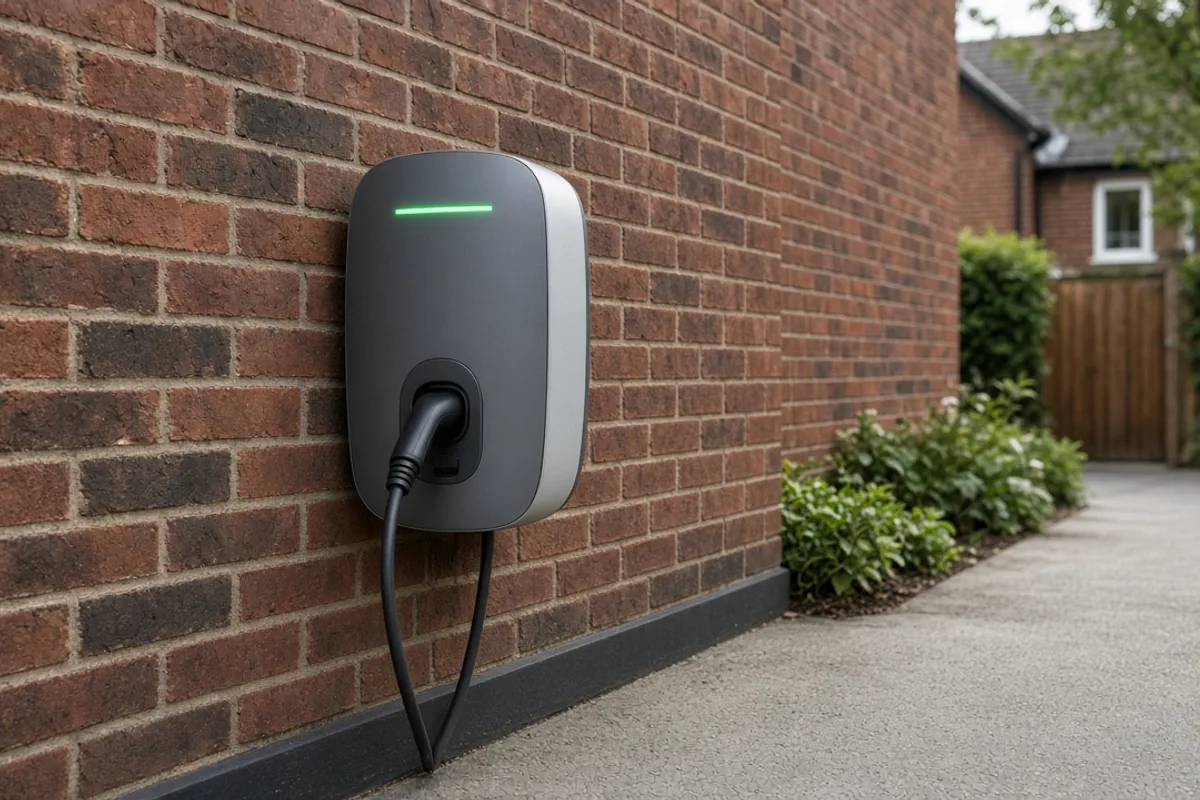
A carport is a good place for a home EV charger: the car, the plug and the charger stay dry. The charger fixes to a sturdy post or a backing board between posts, with the cable run from the house in armoured cable buried or clipped along a wall. The carport must be strong enough to hold the unit, the earthing arrangement must suit an outdoor installation, and a new carport may need to meet planning limits for outbuildings.
Fixing the charger
Home chargers are light, but the cable is pulled and leaned on every day. Fix the unit to a solid post or to a weatherproof backing board spanning two posts, not to thin cladding.
Position the charger so the cable reaches the car's charge port without crossing a walkway, and mount it at the height the manufacturer and installation code suggest. On timber, use fixings suited to outdoor use and keep the unit clear of gutters and downpipes.
Getting power to the carport
If the carport is against the house, the cable can come straight through the wall. A freestanding carport usually needs steel wire armoured cable buried in a trench or clipped along a boundary wall, with the depth and route recorded.
Longer runs need a larger cable to limit voltage drop. Ask the installer to show the cable size and route on the quote, and whether any groundwork, such as lifting block paving, is included.
| Item | When it applies | Typical effect on price |
|---|---|---|
| Backing board or post | Thin posts or open sides | Small |
| Buried armoured cable | Freestanding carport | Rises with trench length and surface |
| Larger cable | Long runs | Moderate |
| Earth rod or open-PEN device | Depends on the supply and charger | Often built into the charger |
| Outdoor isolator | Where the installer specifies | Small |
Earthing and protection
Most UK homes have a PME earthing arrangement. Outdoor EV chargers on PME supplies need protection against an open-PEN fault, which most current chargers include. Otherwise an earth rod and a different arrangement may be needed. The installer decides this from the supply type and the charger.
The charger circuit needs its own RCD protection suitable for EV charging. Ask for the electrical installation certificate and confirmation that the network operator has been notified.
Planning for a new carport
Building a carport and adding a charger at the same time is efficient: the cable route can go in before the base is finished. Carports are often permitted development as outbuildings within height and position limits, but rules differ in front gardens, conservation areas and listed buildings. Check before you build.
A carport also helps with the grant rules for flats and rentals, which require off-street parking the applicant controls. Ask the installer to check eligibility before you rely on a grant.
Frequently asked questions
Can an EV charger be fitted to a wooden carport?
Yes, on a solid post or a backing board between posts, with outdoor-rated fixings.
Does a carport EV charger need an earth rod?
Not usually if the charger has built-in open-PEN protection. The installer decides from the supply type.
Do I need planning permission for a carport?
Often not, as an outbuilding within permitted development limits, but front gardens, conservation areas and listed buildings have extra rules.
How is power run to a freestanding carport?
Usually in steel wire armoured cable, buried or clipped along a wall, sized for the run length.
Core buying guides
Start with these high-intent guides, then dig into the rest of the library.
Related guides
Sources and further reading
How this guide was prepared
This guide was written by the Local EV Installers Editorial Team. We compare official guidance, legislation and established consumer information, separate general information from project-specific advice, and show publication dates and sources. We do not accept installer accreditation claims at face value.